Comprehensive Track Preparation Workflows
A championship weekend is won or lost before Free Practice 1. We outline the step-by-step track conditioning, aggregate scrubbing, line painting, and barrier certification that turns an idle asphalt loop into a competitive circuit.
The Critical 72-Hour Pre-Event Window
In the seventy-two hours leading up to an official test session or race weekend, the circuit undergoes an intense operational transformation. Weather conditions, ambient humidity, and natural dust deposits alter the baseline friction coefficient of the asphalt surface.
Our preparation procedures ensure the track presents consistent, predictable grip characteristics from Turn 1 through to the final straight. We clean out dust, inspect drainage channels, test electronic marshaling loops, and calibrate visual track markers to provide competitors with the safest possible racing surface.
Chronological Preparation Timeline
Methodical execution avoids eleventh-hour delays. Our crews follow a disciplined countdown schedule:
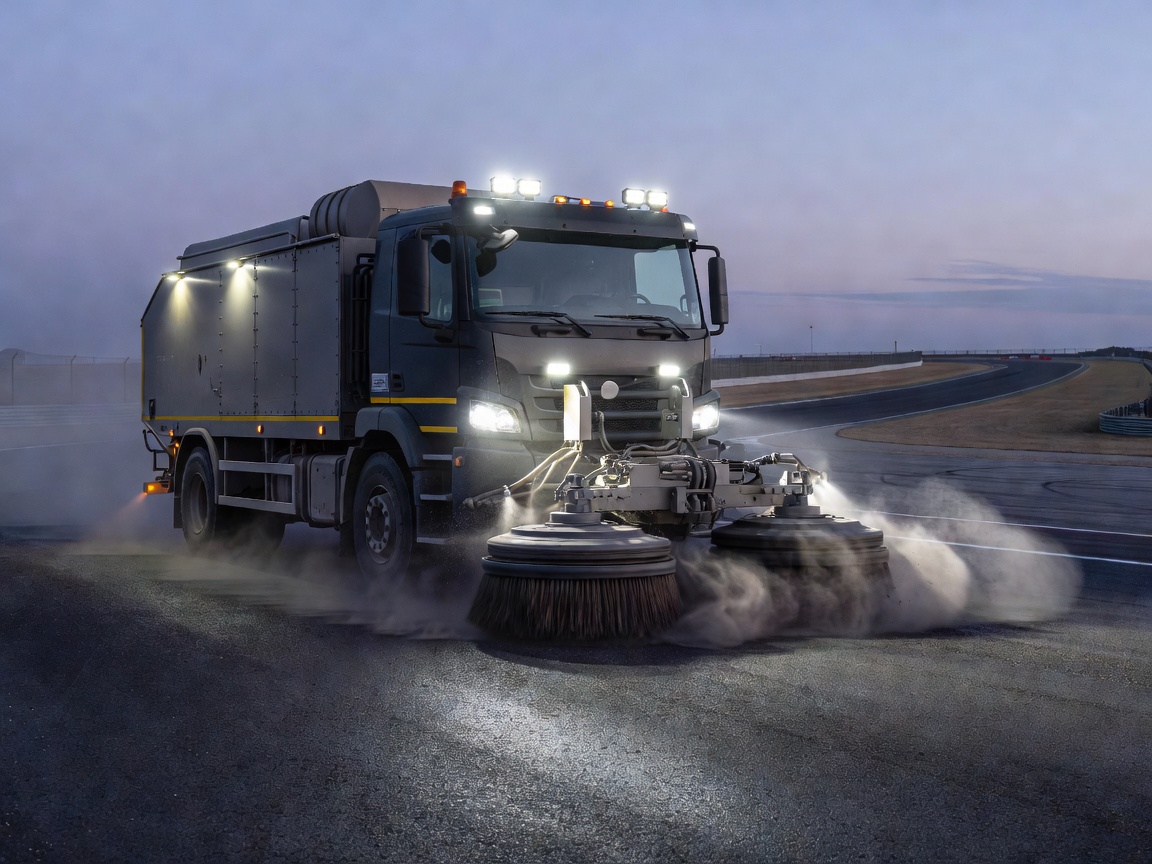
Macro Washing & Hydraulic Vacuum Sweep
High-volume water jets sweep across the entire circuit width at 8 bars of pressure, flushing sub-surface dust and particulate matter from porous asphalt into perimeter catch-basins. Heavy vacuum trucks follow immediately behind to prevent sediment redeposition.
Line Painting & FIA Anti-Slip Coatings
Grid boxes, track limits white lines, pit-in/pit-out blend lines, and curb apexes receive specialized waterborne epoxy paint mixed with micro-glass beads. This guarantees that painted areas deliver friction ratings comparable to raw asphalt in wet conditions.
Electronic Timing & Light Loop Verification
Timing transponder loops embedded in the asphalt are pinged and verified with mobile transponder emulators. FIA light panels and electronic digital flag boards at every marshal post are tested for luminous output and response latency.
Final Safety Car Walk & FOD Sweep
The Track Safety Director, Chief Marshal, and our lead operations officer perform a slow physical circuit drive-through, scanning for Foreign Object Debris (FOD), checking catch-fence cables, and confirming tire stack banding tension.
Rubbering-In: Managing Surface Grip Progression
On freshly washed or newly resurfaced tarmac, the track is termed “green”—meaning it offers low mechanical grip and exhibits high tire degradation. In high-level series, circuit operators deliberately condition the racing line to establish a preliminary rubber baseline.
We use specialized mechanical dragging mats and rubber tire matrices towed at controlled velocities across braking segments and apex points. This embeds a micro-layer of rubber into the microscopic asphalt crevices, minimizing the steep grip evolution curve that otherwise catches out drivers in early sessions.
Weather Contingency: Rain & Standing Water Management
When sudden squalls strike prior to a session, passive drainage may be overwhelmed by heavy downpours. Our teams deploy high-volume squeegee sweepers and tractor-mounted centrifugal blowers to clear standing water from track depressions and run-off strips, preventing hydroplaning and protecting race schedules.
Pre-Event Inspection Checklist for Circuit Managers
Use our field-tested checklist during the final track sign-off:
- Kerb Anchors: Confirm all 19mm anchor bolts on negative curbs are torqued to specified tolerances.
- Drainage Grate Latches: Visually inspect and pull-test all transverse slot drain grates along braking lines.
- Pit Wall Gates: Confirm self-closing latches on all marshaling safety openings operate cleanly without sticking.
- Track Limit Sensors: Verify optical and pressure-sensitive track-limit loops with Race Control data logging.
- Gravel Trap Grooming: Ensure run-off aggregate is uniform, level, and free from debris or weather ruts.
Explore Next Steps
Track preparation leads directly into active Circuit Event Support, while long-term surface preservation is covered in Track Maintenance.
Prepare Your Circuit for the Season Ahead
Consult with our preparation specialists to develop tailored track conditioning regimens and homologation timelines.